
May 7, 2026 – A missing female Eurasian lynx that had been released in central Germany’s Thuringian Forest in 2024 was captured on wildlife cameras with at least one cub in tow, conservation group BUND Thüringen said on Thursday.
The lynx, named Vreni, was released in August 2024, and conservationists lost track of the feline soon after because of a technical defect with her GPS emitter, BUND Thüringen said. After no sign of life for about one and a half years, the lynx was identified by her coat pattern in camera-trap images in February and March, with one picture showing a young lynx following the female at a short distance.
“We are overjoyed that Vreni is still alive and that she is still in the Thuringian Forest,” Markus Port, a lynx expert at BUND Thüringen, said in the statement. “When I discovered the lynx and her cub while reviewing the camera-trap images, it was one of the great moments of our project for me.”
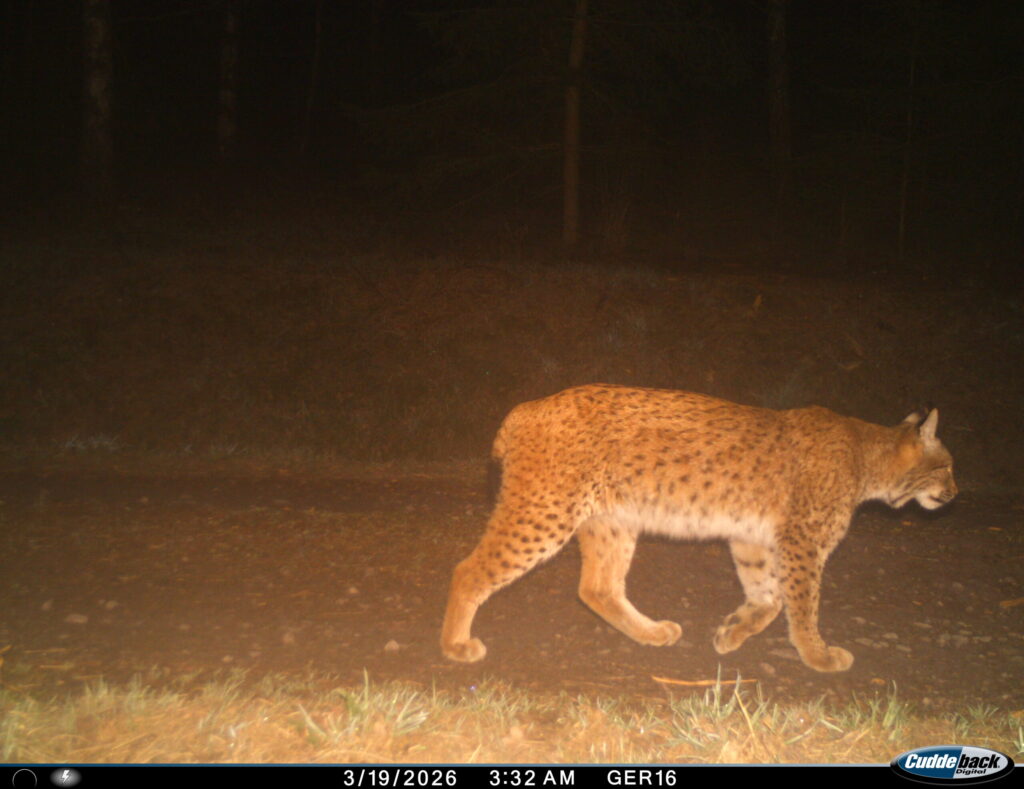
Wild lynx populations in Western and Central Europe are under severe pressure, according to Wildnispark Zurich, where Vreni was born. Individual populations are sometimes very small and poorly interconnected, which threatens genetic diversity, and targeted reintroductions help connect and strengthen populations.
The young animal seen in the picture trailing the female lynx is already almost fully grown, and was probably born in the spring of 2025, according to BUND Thüringen. Lynxes give birth to two to four cubs a year, typically in May or June.
The fact that Vreni was able to reproduce successfully in the first year after her release into the wild is “a great success” for the project, according to Port.
After the project team spotted Vreni in images from a private wildlife camera, the lynx project team set up their own cameras in the area in November 2025.
Vreni was born in Switzerland’s Wildnispark Zurich in the spring of 2023, and is the first lynx born in captivity to give birth in the wild in Germany since the end of a resettlement project in the Harz National Park in the early 2000s, according to BUND Thüringen.
The lynx was released in 2024 as part of a joint project of ten partners, including BUND, which is itself part of the Linking Lynx network that aims to establish a stable lynx population in Central Europe.
The Thuringian Lynx project aims to introduce as many as 20 lynx in the Thuringian Forest between 2024 and 2027, with the long-term goal of creating a stable population core linking the lynx populations in Germany’s Harz Mountains and the Bavarian Forest. Monitoring data and modeling had indicated that natural colonization of the Thuringian Forest was unlikely for the next 20 to 30 years.
Many of the lynx released in the Thuringian Forest come from the conservation breeding program of the European Association of Zoos and Aquariums, according to BUND Thüringen. Sixteen lynx born in zoos have been released into the wild in Germany since the beginning of 2023, including Vreni as well as her sisters Verena and Freya from Wildnispark Zurich, the park said.