
May 16, 2026 – The project to restore part of the Elbe River floodplain has moved from planning into implementation in a second phase that will include hydrological engineering to reconnect cut-off river arms to the main channel, according to Germany’s Federal Ministry for the Environment and the Federal Agency for Nature Conservation.
A former arm of the Elbe known as the Alte Elbe bei Bösewig is among the sites targeted for reconnection over the next decade, the ministry said in a statement on May 12. The project aims to improve floodplain conditions and combine nature restoration with climate resilience, restoring species-rich floodplain grassland and strengthening water retention.
“Intact floodplains are essential for survival for many animal species,” Federal Environment Minister Carsten Schneider said in the statement. “At the same time, intact floodplains are an effective protection for us humans from the consequences of climate change.”
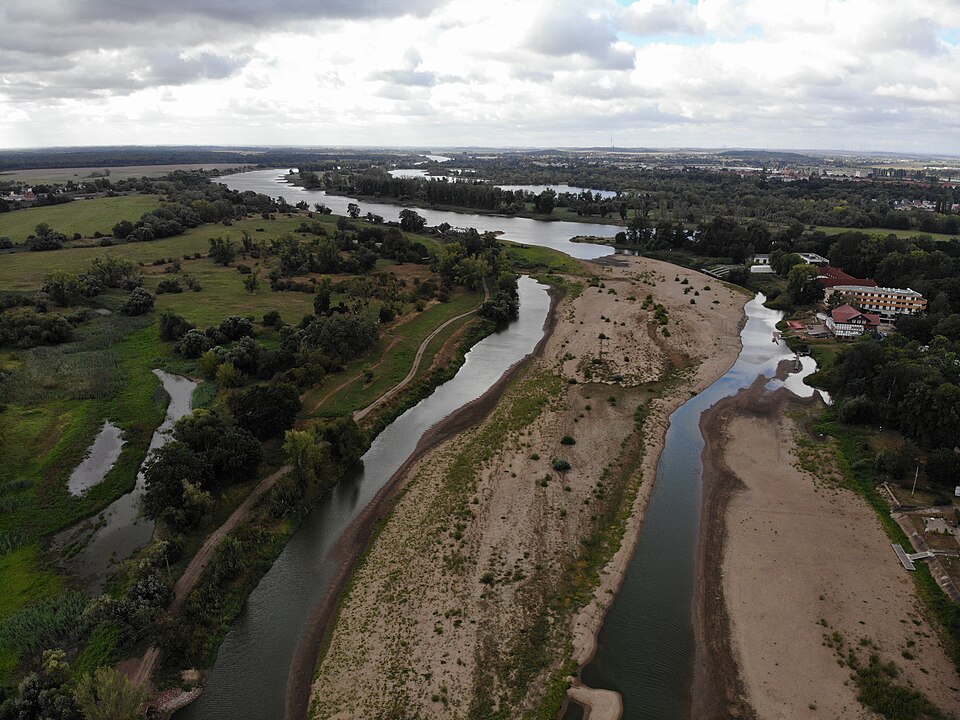
Across Europe, many major rivers are heavily modified or artificial due to channelisation, dredging and flood-protection works, leaving little space for natural water retention during extreme rainfall events. That has led governments to increasingly turn to nature-based solutions as a response, with the Netherlands also restoring old channels and floodplains to give rivers more space during floods.
While river and floodplain ecosystems are considered to be among Europe’s most biologically diverse ecosystems, they’re also among the most degraded. The European Union’s Biodiversity Strategy for 2030 aims to restore at least 25,000 kilometers of free-flowing rivers by 2030 through removal of barriers and restoring floodplains and wetlands.
The former river arm near Bösewig supports several duck species including the garganey (Spatula querquedula) and provides breeding habitat for amphibians such as the fire-bellied toad (Bombina bombina), according to the Saxony-Anhalt State Administrative Office. The wetlands also serve as a feeding area for both black storks (Ciconia nigra) and white storks (Ciconia ciconia).
Intensive agricultural use has left many of the surrounding meadows species-poor, with declining meadow bird populations. Lapwings (Vanellus vanellus) have decreased locally, while breeding attempts by the black tern (Chlidonias niger) have repeatedly failed because of grazing pressure, according to the state administration.
The second phase of the Mittelelbe-Schwarze Elster project will receive around €56 million in funding from the German action program for natural climate protection, the Aktionsprogramm Natürlicher Klimaschutz, with additional funds from the state of Saxony-Anhalt and the Heinz Sielmann Foundation.
The project area covers around 4,452 hectares near the town of Wittenberg, in the east of Saxony-Anhalt. The planned measures will restore the natural dynamics between the river and the floodplain, according to the ministry.